Copper Equivalent (CuEq) Formula and Calculator for Drill Results
CuEq (%) = Cu (%) + the sum of factor × grade for each other metal. Each factor is that metal's recovered value per unit of grade divided by the recovered value of 1% copper. At US$4.50/lb copper and US$3,000/oz gold, with 90% copper and 80% gold recovery, the gold factor is 0.864, so 0.45% Cu with 0.30 g/t Au is 0.71% CuEq. Wherever a CuEq number appears, state the prices, recoveries and formula behind it.
What a copper equivalent grade is for
Porphyry and other polymetallic deposits carry value in more than one metal. A copper equivalent (CuEq) grade expresses the gold, silver, molybdenum or zinc in an interval as the amount of copper that would be worth the same, so a single number can rank intervals, colour a drill figure or summarise a hole. It is a convenience for comparison. It is not an assay, and it is only as good as the prices and recoveries chosen, which is why readers expect to see them next to the number.
The formula
Work out what one unit of each metal's grade is worth per tonne at its price, multiply by its recovery, and divide by the same figure for 1% copper. That ratio is the metal's factor. Then add each metal's grade multiplied by its factor to the copper grade.
| Term | Meaning |
|---|---|
| CuEq | Cu + F(Au) × Au + F(Ag) × Ag + F(Mo) × Mo + … |
| F(metal) | (value per tonne of one grade unit of the metal × its recovery) ÷ (value per tonne of 1% Cu × copper recovery) |
| Value of 1% Cu | 22.0462 lb per tonne × copper price in US$/lb |
| Value of 1 g/t Au or Ag | (1 ÷ 31.1035) troy oz per tonne × price in US$/oz |
| Recovery | Expected metallurgical recovery as a fraction, or 100% for an in-situ equivalent |
Unit conversions that trip people up
Most CuEq mistakes are unit mistakes. Base metals are priced per pound and reported in percent; precious metals are priced per troy ounce and reported in grams per tonne. The conversions below are the whole trick.
A troy ounce is 31.1035 g, not the 28.35 g avoirdupois ounce. Using the wrong one inflates a gold factor by about 10%. A pound is 453.592 g, which is where 22.0462 lb per tonne for each 1% comes from (10,000 g ÷ 453.592 g). Example prices here are illustrative; use the prices your QP has approved.
| Grade | Per tonne | Value at an example price |
|---|---|---|
| 1% Cu | 10,000 g = 22.0462 lb | US$99.21 at US$4.50/lb |
| 1 g/t Au | 0.032151 troy oz | US$96.45 at US$3,000/oz |
| 1 g/t Ag | 0.032151 troy oz | US$1.13 at US$35/oz |
| 1% Mo | 22.0462 lb | US$440.92 at US$20/lb |
| 1 ppm | 1 g/t | Same as g/t |
| 1 ppb | 0.001 g/t | One thousandth of g/t |
Worked example 1: copper and gold, with recoveries
Assume US$4.50/lb copper at 90% recovery and US$3,000/oz gold at 80% recovery. 1% copper is worth 22.0462 × 4.50 = US$99.21 per tonne; recovered, US$89.29. 1 g/t gold is worth 3,000 ÷ 31.1035 = US$96.45 per tonne; recovered, US$77.16. The gold factor is 77.16 ÷ 89.29 = 0.864.
An interval of 0.45% Cu and 0.30 g/t Au is then 0.45 + 0.864 × 0.30 = 0.71% CuEq. Without recoveries (100% for both) the factor would be 96.45 ÷ 99.21 = 0.972, and the same interval would be 0.74% CuEq. That gap is why the recoveries must be stated.
Worked example 2: adding silver
With silver at US$35/oz and 80% recovery, 1 g/t silver is worth US$1.125 per tonne, US$0.90 recovered, giving a factor of 0.90 ÷ 89.29 = 0.0101. Add 4 g/t Ag to the interval above and the equivalent rises by 0.04, to 0.75% CuEq. Silver rarely moves a copper equivalent much, but it should still be listed in the formula if it is included.
Worked example 3: molybdenum reported in ppm
Molybdenum is priced per pound like copper but often reported in ppm. At US$20/lb and 85% recovery, 1% Mo is worth US$440.92 per tonne, US$374.79 recovered, so the factor per 1% Mo is 374.79 ÷ 89.29 = 4.20. Per ppm it is 4.20 ÷ 10,000 = 0.00042. An interval with 200 ppm Mo (0.02%) therefore adds 0.084% CuEq. Applying the per-percent factor to a ppm column would overstate molybdenum ten-thousand-fold, so convert or label units before you calculate.
Gold equivalent (AuEq) works the same way
For a gold project, swap the base metal. AuEq (g/t) = Au + F(Cu) × Cu + F(Ag) × Ag, with each factor now divided by the recovered value of 1 g/t gold. With the prices and recoveries from example 1, the copper factor is 89.29 ÷ 77.16 = 1.157 g/t AuEq per 1% Cu. An interval of 1.20 g/t Au and 0.25% Cu is 1.20 + 1.157 × 0.25 = 1.49 g/t AuEq. At equal gold and silver recoveries the silver factor is simply the price ratio, 35 ÷ 3,000 = 0.0117, so 15 g/t Ag adds 0.18 g/t AuEq.
Recoveries: which ones, and from where
An equivalent that applies recoveries is closer to what could be produced; one without them (in-situ) is simpler but overstates metals that recover poorly. Neither is wrong as long as the basis is stated. Recoveries should come from metallurgical test work or a reasoned assumption the QP is prepared to stand behind; a metal with no recovery basis at all is often better left out of the equivalent than included at an optimistic number. Prices and recoveries change, so date the assumptions and keep them identical across every figure and table in a release.
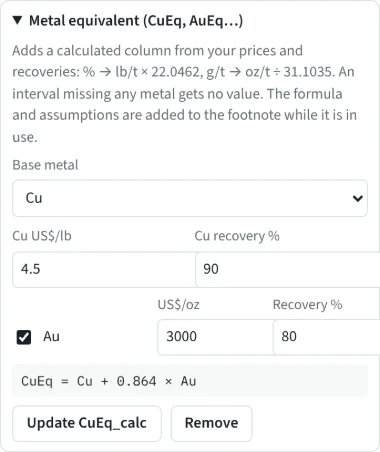
The calculator in Exploration Maps 3D
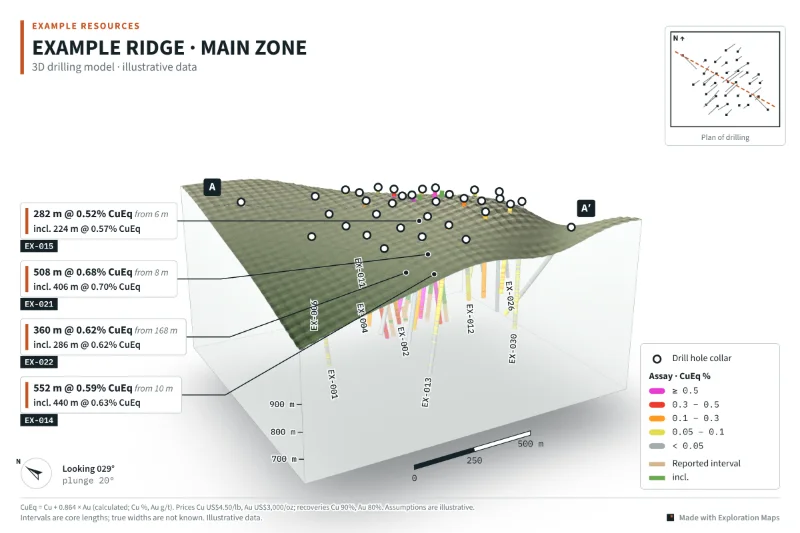
In the Layout step of Exploration Maps 3D, open Metal equivalent (CuEq, AuEq…). Choose the base metal, enter its price and recovery, tick the other metals and enter theirs. The tool adds a calculated column, for example CuEq_calc, shows the formula with each factor to three significant figures, and colours the holes by it. While the column is in use, the formula, prices and recoveries are written into the figure's footnote, so the figure cannot be separated from its assumptions. Defaults are illustrative (Cu US$4.50/lb, Au US$3,000/oz, Ag US$35/oz, Mo US$20/lb, Zn US$1.30/lb, recoveries 90%); replace them with yours.
Two behaviours matter for honest numbers. An interval missing any metal in the formula gets no equivalent value rather than being treated as zero. And a value written as "<0.01" is read as 0.01, so if your convention for below-detection results is half the detection limit or zero, convert the column before loading it. Try it on the sample in Exploration Maps 3D, or follow the full 3D figure guide.
What to state next to a CuEq number
- The formula, with each factor
- Metal prices and the date or basis they were chosen on
- Recoveries used and their basis, or that the equivalent is in situ
- Which metals are included, and how missing or below-detection values were handled
- That the equivalent is calculated, not assayed, with the individual metal grades also reported